Thursday, September 3
10:00-11:00 | Mechanics of Dynamic Wind Effects: Fundamentals to Frontiers
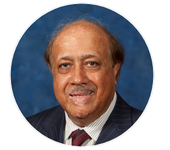
Ahsan Kareem, Ph.D., NAE, F.EMI, Dist.M.ASCE
Robert M. Moran Professor of Engineering
Director, NatHaz Modeling Laboratory
University of Notre Dame
Abstract
There is a recent trend in the escalation of the extremes of natural hazards around the globe, with an emphasis on meteorological hazards. Over the last several decades, wind engineering, a multi- disciplinary subject involving engineering meteorology, fluid dynamics, structural dynamics, structural engineering, probabilistic methods, and design has addressed the challenges posed by extremes in winds of synoptic and non-synoptic origins. During this period, we have seen extraordinary advances in experimental facilities, instrumentation, and data acquisition and management. These advances have enabled us to build a cadre of civil infrastructure that meets some of the challenges posed by extreme windstorms. Yet there remain several frontiers that still need to be addressed. Fortunately, amidst these challenges, there are new opportunities to complement our existing capabilities as the burgeoning growth in computational hardware/resources and parallel computational advances, coupled with data analytics and AI-based schemes, e.g., machine learning, holds the promise of expanding our modeling, simulation, and analysis capacity far beyond what our current conventional schemes offer. This presentation provides a synopsis of the challenges posed by extremes and expands on new computational opportunities to address emerging challenges in building resilient and sustainable civil infrastructure as we shift from code-based and performance-based to resilience-based design.
Biography
Ahsan Kareem, Dist. FASCE, NAE, is the Robert M. Moran Professor of Engineering in the Department of Civil & Environmental Engineering and Earth Sciences (CEEES) at the University of Notre Dame. He has served as the President of the American Association of Wind Engineering (AAWE) and the International Association of Wind Engineering (IAWE). The focus of his work is on quantifying load effects caused by various natural hazards on structures and to develop innovative strategies to manage and mitigate their effects. This includes characterization and formulation of dynamic load effects due to wind, waves and earthquakes on tall buildings, long-span bridges, offshore structures and energy-related structures that is carried out via fundamental analytical and computational methods, and experiments at laboratory, and full-scale. He directs NatHaz Group (NatHaz Modeling Laboratory), which focuses on developments in cyberspace virtual collaborative research platforms, e.g., virtual organizations, IoT, edge computing, crowdsourcing, computational intelligence, living laboratories, sensing and actuation, citizen sensing, web-enabled analysis and design, scientific machine learning (SciML) and cloud-based computing to address challenges posed by natural hazards to the built environment.
He has received several medals and awards for his distinguished contributions in several areas including the von Karman Medal 2015; Jack E. Cermak Medal 2002; Robert H. Scanlan Medal 2005; A. G. Davenport Medal 2007; James Croes Medals, 2015 & 2022; Masanobu Shinozuka Medal, 2017; Earnest Howard Medal, 2019; Nathan M. Newmark Medal, 2021; Archimedes Medal 2025. He is a Distinguished Member of ASCE, a recipient of the Award of Merit from IABSE and IASSAR’s Distinguished Research Award.
He is a member of the US National Academy of Engineering, the Chinese Academy of Engineering, the Indian Academy of Engineering, the Japan Academy of Engineering, the European Academy of Sciences and Arts, the European Academy of Sciences and a fellow of the American Association for Advancement of Science.